Sunday, May 6, 2012
My Final Thoughts
As we wrap up this blog for the semester and our class, I feel like I should say something about what I've learned. I did not realize it, but before I took this class, I had no clue about anything to do with the artworld. This course has taught me a lot of interesting things to think about when it comes to art. I've pondered over whether art is an imitation of an imitation and over whether or not beauty is the promise of happiness. To be honest, I did not think the definition of what art is was so argued upon before this class. I leave this class no more sure of what is art, but I feel like I know reasons why art is so hard to pinpoint. I feel educated and can feel more right in saying that I'm a core member of the artworld.

Final Blog 02
- Does this theory imply that we chose to be moved?I think the pretend theory does imply that we choose to be moved. If we accept all of the premises laid out in this weeks reading, then we are certainly led down the garden path into thinking so. Things rouse emotion in us involuntarily. Sometimes, I have played video games that were happy and light hearted and knew they were such, only to have them make me feel a little sad. There are even works of fiction that my friends are interested in that I do not have any knowledge about or watch that have roused feelings in me. I saw an animation of one of my friends' shows and I glanced at it and experienced emotion. I do not think that I was pretending to understand what was going on or pretending anything at all.
Final Blogs 01
- Are there any works of fiction that might produce strong emotions other than quasi-emotions?I feel like that, on occasion, works of fiction might produce emotions stronger than quasi-emotions, but I don't think that they are entirely produced by the works of fiction themselves. I think that if there is a case when very strong emotions are displayed by a person after, for example, reading a book, the reader must have experienced a similar feeling before. In case like this, it's because the reader had a connection to the story and possibly reading the story triggered the memory, thus evoking the feeling. There are no particular works of fiction that could do this, because everyone is different and has different experiences.
Response to TA's final question
"Think back to the last time you played make-believe. Compare it to
reading a book or enjoying some other narrative art-form. Are they
completely the same? What are some similarities? Differences?"
I don't remember exactly the last time I played make-believe, but I think the differences between reading a book or experiencing some other narrative art-form is that make believe is more limited. When someone pretends something, that person is limited to what they can imagine. What a person can experience in a book is up to the author's imagination and own experiences. What an adult can make-believe is very different from what a child can imagine. A child does not know nearly as much as a seasoned adult. While there are those differences, I think the emotions can be similar. Sometimes when I think of stories that are sad, I can be overcome with as much emotion as a sad book I've read. But what I can pretend is limited to who I am as a person. Sometimes, I can read things that make me so uncomfortable and embarrassed, and I have trouble conjuring up the same feelings without the guide of text.
I don't remember exactly the last time I played make-believe, but I think the differences between reading a book or experiencing some other narrative art-form is that make believe is more limited. When someone pretends something, that person is limited to what they can imagine. What a person can experience in a book is up to the author's imagination and own experiences. What an adult can make-believe is very different from what a child can imagine. A child does not know nearly as much as a seasoned adult. While there are those differences, I think the emotions can be similar. Sometimes when I think of stories that are sad, I can be overcome with as much emotion as a sad book I've read. But what I can pretend is limited to who I am as a person. Sometimes, I can read things that make me so uncomfortable and embarrassed, and I have trouble conjuring up the same feelings without the guide of text.
Sunday, April 29, 2012
Week 10 Q&A02
"2. Does there need to be knowledge (content) in art?"
Good art should have some sort of content. In regards to imagination and creativity, it is all well and good if an artist successfully and masterfully created a work relying on their skill, but if there is no content, it does not have the same sort of meaning. Even the imagination and creativity should be based off of some prior knowledge and understanding, so even if there is no meaty content, there might be a little bit of content in regards to, for example, the brushstrokes. I think the content in the artwork, and by that I mean what its trying to communicate, is as important as the creativity executed in it and the imagination portrayed.
Good art should have some sort of content. In regards to imagination and creativity, it is all well and good if an artist successfully and masterfully created a work relying on their skill, but if there is no content, it does not have the same sort of meaning. Even the imagination and creativity should be based off of some prior knowledge and understanding, so even if there is no meaty content, there might be a little bit of content in regards to, for example, the brushstrokes. I think the content in the artwork, and by that I mean what its trying to communicate, is as important as the creativity executed in it and the imagination portrayed.
Week 10 Q&A 01
"1. Is it possible to imagine without any prior knowledge?"
I don't think it is possible to imagine anything without some sort of base knowledge. I believe that our imagination roots off of things we have already somewhat experienced. A person who cannot see color cannot fathom color unless they saw it once. We need certain knowledge in order to understand. A person who does not have the ability to smell cannot truly understand scent in a story. They might get the effect, but not fully. Our prior knowledge and experiences shape our imagination. If one can conceive of it, if there was a person who was unable to sense anything going on in the world around them, would they be able to imagine any thing at all? I don't know if they could imagine a fraction of what we imagine.
I don't think it is possible to imagine anything without some sort of base knowledge. I believe that our imagination roots off of things we have already somewhat experienced. A person who cannot see color cannot fathom color unless they saw it once. We need certain knowledge in order to understand. A person who does not have the ability to smell cannot truly understand scent in a story. They might get the effect, but not fully. Our prior knowledge and experiences shape our imagination. If one can conceive of it, if there was a person who was unable to sense anything going on in the world around them, would they be able to imagine any thing at all? I don't know if they could imagine a fraction of what we imagine.
Sunday, April 22, 2012
Nehamas - Beauty and Pregnancy
While writing my blogs this week, I was thinking about Nehamas' definition of beauty, how it can be applied to non-artifacts, and pregnancy. It is interesting to think of pregnancy in these terms. I've heard that each pregnancy is different from the other, and the mothers are surprised at what they learn from each one. I think therefore, beauty being the promise of happiness and everything, it could be applied to pregnancy. If no two are the same and there is a seemingly endless things to learn about it, then it is not a stretch to call it beautiful. Some might thing childbirth is disgusting, but "I might find beautiful what other find disgusting." (Nehamas). It does not carsickness have to be the same kind of beauty that we find attractive.
What are other human acts that could be beautiful?
What are other human acts that could be beautiful?
Week 9 Q&A 02
"2. If something beautiful has something more to offer, are some of the things beautiful about it outside the scope of human imagination?"
I think I was misunderstanding Nehamas when I wrote this question. If we find something beautiful, in Nehamas' opinion, we see or envision a promise of happiness that has yet to be fulfilled. Maybe the thing we are trying to discover about it is hard for us to understand. What I find interesting about this definition of beauty is that it can be applied to non-artifacts. Many find pregnancy and childbirth to be beautiful, and it is not (arguably) a work of art. There is so much to understand and learn about pregnancy, no one person can learn everything about it in their lifetime. We might not understand it all, but I don't think its outside the scope of human imagination.
I think I was misunderstanding Nehamas when I wrote this question. If we find something beautiful, in Nehamas' opinion, we see or envision a promise of happiness that has yet to be fulfilled. Maybe the thing we are trying to discover about it is hard for us to understand. What I find interesting about this definition of beauty is that it can be applied to non-artifacts. Many find pregnancy and childbirth to be beautiful, and it is not (arguably) a work of art. There is so much to understand and learn about pregnancy, no one person can learn everything about it in their lifetime. We might not understand it all, but I don't think its outside the scope of human imagination.
Week 9 Q&A 01
1. Is it possible to be finished with examining any work of art, beautiful or not?
I think when Nehamas said that "beauty is the promise of happiness," it doesn't necessarily have to mean that it will fulfill that promise. We could possibly exhaust viewing a painting. We might have seen everything that we can see in it that the artist meant for us. But, if it's truly beautiful, we feel this attraction, this hold on the painting, that we continue to examine it. As Nehamas said, it might disappoint us. It may be a fruitless endeavor, but if we find it beautiful, it will remain beautiful to us. Something that isn't beautiful, such as an attractive couch, may be mistaken as beautiful, but eventually, we'll stop noticing its attractiveness. Truly beautiful things are not like that.
I think when Nehamas said that "beauty is the promise of happiness," it doesn't necessarily have to mean that it will fulfill that promise. We could possibly exhaust viewing a painting. We might have seen everything that we can see in it that the artist meant for us. But, if it's truly beautiful, we feel this attraction, this hold on the painting, that we continue to examine it. As Nehamas said, it might disappoint us. It may be a fruitless endeavor, but if we find it beautiful, it will remain beautiful to us. Something that isn't beautiful, such as an attractive couch, may be mistaken as beautiful, but eventually, we'll stop noticing its attractiveness. Truly beautiful things are not like that.
Sunday, April 8, 2012
Week 8 Q&A 02
"2. What does Dickie mean by “candidate for appreciation by some person?"
By "candidate for appreciation," Dickie means that it may be considered to be viewed as art. Once a person sees something and says "that's a work of art," then they may view it as such, but others will judge it accordingly as well. Anyone who's a member of the artwork can judge something as a work of art, but whether or not that really is is up for debate. Especially if it's being judged by someone who doesn't really know what art is truly, then it doesn't have to be art. It works well as a safety measure to protect the artworld from being a free for all.
By "candidate for appreciation," Dickie means that it may be considered to be viewed as art. Once a person sees something and says "that's a work of art," then they may view it as such, but others will judge it accordingly as well. Anyone who's a member of the artwork can judge something as a work of art, but whether or not that really is is up for debate. Especially if it's being judged by someone who doesn't really know what art is truly, then it doesn't have to be art. It works well as a safety measure to protect the artworld from being a free for all.
Week 8 Q&A 01
"1. Does Dickie mean that any person who wants to be a member of the artworld can?"
I think by that, he means that the artworld doesn't have to be closed off to those who are "gifted" or expert critics. If someone wants to know more about art and enjoy it, then they shouldn't be looked down doing so. However, while Dickie might consider them a core member of the artworld, he thinks there is another core within it. That core includes artists and critics. I think within that core, they happen to be more right than the first core. They have a wider knowledge than someone who just goes to a theatre sometimes. But by saying that anyone can be a part of the artworld, it shows the artworld as more accepting and open.
I think by that, he means that the artworld doesn't have to be closed off to those who are "gifted" or expert critics. If someone wants to know more about art and enjoy it, then they shouldn't be looked down doing so. However, while Dickie might consider them a core member of the artworld, he thinks there is another core within it. That core includes artists and critics. I think within that core, they happen to be more right than the first core. They have a wider knowledge than someone who just goes to a theatre sometimes. But by saying that anyone can be a part of the artworld, it shows the artworld as more accepting and open.
Response to TA's question 10
"On page 431 in our book, Dickie claims that institutional formality and rules for art “would threaten the freshness and exuberance of art.” In what ways would rules and formalities do this? In what ways could these things promote and sharpen creativity? Is it possible to conceive of art without a certain set of rules and expectations?"
I think that it's very hard to imagine art without a certain set of rules and expectations. If we say there are no rules to art, then anything goes. I do think, however, we tend to close off art and try to define it. Then, at times, we see something and know it to be art, and we realize that the definition has to be expanded to include it. I do believe there is a stopping point, but we have trouble conceiving it because we keep trying to close it off and define it.
I think that it's very hard to imagine art without a certain set of rules and expectations. If we say there are no rules to art, then anything goes. I do think, however, we tend to close off art and try to define it. Then, at times, we see something and know it to be art, and we realize that the definition has to be expanded to include it. I do believe there is a stopping point, but we have trouble conceiving it because we keep trying to close it off and define it.
Sunday, April 1, 2012
Music
While I'm sure the music that Kivy and Hanslick were discussing in their essays was fine, classical music, I was wondering where that left the music that a lot of critics wouldn't think highly of. They seemed to suggest that there was some sort of content in the music. But many people who enjoy music that isn't classical music would say that they can be profoundly touched by songs. They may not be able to explain how they feel about their music. Would that be the same sort of content? Or does the music have to be considered "true" music to have such content, putting the rest of the music in a category where it is just tones and sounds?
Response to TA's question 09
"Kivy seems to propose that the subject of music is the emotional quality it brings forth in us. This seems to contradict Hanslick, who holds that only things we can voice in words are content and the emotional/aesthetic qualities of music do not belong in this.
Hanslick seems to imply, though, that there is something in music that we simply cannot put into words. What do you think this might be? Do you think he's right, that there is something mysterious and inaccessible to us in music? Does Kivy's proposal of emotional content hold against Hanslick's thesis?"
Music affects us in a profound way. Sometimes, it affects people differently, but I don't the qualities we perceive in music are actually in the music itself. Whether we feel happy or sad when listening to something is something I believe that we pick up. I think the composer knows how to affect us. We derive the content from the music and decide it.
I do think that there might be something we might not be able to ever understand in music. The feelings we experience when we listen to music are not wrong, but they might possibly be a hint of something that we're not fully understanding. For us as we are though, we base the content of the song on how it makes us feel.
Hanslick seems to imply, though, that there is something in music that we simply cannot put into words. What do you think this might be? Do you think he's right, that there is something mysterious and inaccessible to us in music? Does Kivy's proposal of emotional content hold against Hanslick's thesis?"
Music affects us in a profound way. Sometimes, it affects people differently, but I don't the qualities we perceive in music are actually in the music itself. Whether we feel happy or sad when listening to something is something I believe that we pick up. I think the composer knows how to affect us. We derive the content from the music and decide it.
I do think that there might be something we might not be able to ever understand in music. The feelings we experience when we listen to music are not wrong, but they might possibly be a hint of something that we're not fully understanding. For us as we are though, we base the content of the song on how it makes us feel.
Thursday, March 29, 2012
Response to Hannah
Link to original post.
It is very interesting to think of humans as artifacts. If humans are just artifacts of humans previous, then it's hard to say what isn't an artifact. Not considering how people raise children, just giving birth to a child could be considered creating an artifact. The majority of Mount Greylock can be an artifact because of the replanted trees. If we think like this, it's hard to think how many non-artifacts there are left in the world.
It is very interesting to think of humans as artifacts. If humans are just artifacts of humans previous, then it's hard to say what isn't an artifact. Not considering how people raise children, just giving birth to a child could be considered creating an artifact. The majority of Mount Greylock can be an artifact because of the replanted trees. If we think like this, it's hard to think how many non-artifacts there are left in the world.
Sunday, March 25, 2012
Response to TA's question 08
"Allen Carlson quotes Hepburn in saying that people who have the wrong sort of education or aren't in the right mindset to appreciate nature will either pay little heed to it or will look at it "the wrong way". Carlson seems to imply that for each setting there is a "right" mindset to have and way to view the landscape/ flower/ summer afternoon.
Is this true? Or is it possible that there are multiple "right" ways to view a natural environment? Or is there no "right" way and perhaps only shades of appreciation?"
I think there can be many ways to appreciate nature. For example, let's use the fibonacci spiral. In nature, the fibonacci spiral appears in plants and shells. A person who appreciates math may not know what type of flower it is or care what colors it has in it, but they can certainly appreciate the placement of the petals and how it spirals in such a way. A person who has no knowledge of math, but of flowers in general can appreciate the flower for much more beyond that. I think this can happen in shades too. Like, if you know of fibonacci numbers and that they appear in nature but not much more beyond the math concept, you may appreciate a few shades lighter of what the mathematician feels.
Is this true? Or is it possible that there are multiple "right" ways to view a natural environment? Or is there no "right" way and perhaps only shades of appreciation?"
I think there can be many ways to appreciate nature. For example, let's use the fibonacci spiral. In nature, the fibonacci spiral appears in plants and shells. A person who appreciates math may not know what type of flower it is or care what colors it has in it, but they can certainly appreciate the placement of the petals and how it spirals in such a way. A person who has no knowledge of math, but of flowers in general can appreciate the flower for much more beyond that. I think this can happen in shades too. Like, if you know of fibonacci numbers and that they appear in nature but not much more beyond the math concept, you may appreciate a few shades lighter of what the mathematician feels.
Sunday, March 18, 2012
Week 7 Q&A 02
"If Object A is perceptually indistinguishable from Object B and Object B is considered art, what is Object A?"
 If two things are perceptually indistinguishable from the other and one is art, it does not make the other thing art by proxy. Even if they are visually the same, the content and meaning behind the pieces can be completely different from each other. In the book, Danto used the Brillo Box example. The Brillo Boxes look no different from each other, but their content is completely different from each other. The Brillo Box in the museum is trying to make some statement about life or something. The Brillo boxes found in the store are just trying to hold the Brillo pads; that is it's only purpose. That's why the Andy Warhol pieces are in a museum, but all other Brillo Boxes are on Supermarket shelves.

Week 7 Q&A 01
"1. What about forgeries – can they be identified under “the is of artistic identification?"
I think when I asked myself this question I was really asking if forgeries could be considered art in Danto's point of view. Forgeries are simply copies. After a bit of thought, if forgeries are copies, then what about things that are reprinted? Poems and stories are printed countless times and they are simply copies of the original piece. Paintings are printed and they too are hung up and appreciated the same way. I think forgeries can be identified as art in some aspects, even without truly being art.
I think when I asked myself this question I was really asking if forgeries could be considered art in Danto's point of view. Forgeries are simply copies. After a bit of thought, if forgeries are copies, then what about things that are reprinted? Poems and stories are printed countless times and they are simply copies of the original piece. Paintings are printed and they too are hung up and appreciated the same way. I think forgeries can be identified as art in some aspects, even without truly being art.
Response to TA's question 07
"Danto says that the existing theories on art shape our view of art and enable us to see art at all.
Give an example from your own life in which you only fully understood and appreciated a work of art after it and the theory surrounding had been explained to you. Now think of a work of art you still dislike/don't understand and assess how an understanding of the theory behind it could change your mind."
Sometimes, I've read things, such as poetry, and I just didn't get it. Last year in one of my classes, I read a poem by an Irish author that dealt with a man who turned into a woman over night. I didn't understand what was going on in the poem at all, and I looked it up and found out that it was based on a very old folktale. After I got that, I appreciated it more in a way I didn't before.
Shakespeare is something I've never really understood. I read some things by him that I liked, but other stuff I didn't get into and just wrongly assumed it was overhyped. I definitely don't understand Shakespeare completely, but I've learned many things about it, and while reading his plays and prose, I have a great deal of respect for the man. For example, his use of language is something I didn't understand. I later found out he had a vocabulary of over 29000 words. From this, I've gotten a great appreciation of his use of language that I didn't have before.
Give an example from your own life in which you only fully understood and appreciated a work of art after it and the theory surrounding had been explained to you. Now think of a work of art you still dislike/don't understand and assess how an understanding of the theory behind it could change your mind."
Sometimes, I've read things, such as poetry, and I just didn't get it. Last year in one of my classes, I read a poem by an Irish author that dealt with a man who turned into a woman over night. I didn't understand what was going on in the poem at all, and I looked it up and found out that it was based on a very old folktale. After I got that, I appreciated it more in a way I didn't before.
Shakespeare is something I've never really understood. I read some things by him that I liked, but other stuff I didn't get into and just wrongly assumed it was overhyped. I definitely don't understand Shakespeare completely, but I've learned many things about it, and while reading his plays and prose, I have a great deal of respect for the man. For example, his use of language is something I didn't understand. I later found out he had a vocabulary of over 29000 words. From this, I've gotten a great appreciation of his use of language that I didn't have before.
Sunday, March 4, 2012
Week 6 Q&A 02
"2. Does Weitz's theory of art “cheapen” the value of great art?"
For closed definitions, like a square, no square is "better" than another. If it is, then the thing it's being compared to is probably not a square. All squares are squares, and that's simply that. But art has an open definition, and it's very subjective. People have preferences. If what a child draws with crayon is art, then it can be compared to the Mona Lisa. Modern art, which many do not appreciate, can then be compared to classic art. I think in this aspect, it can "cheapen" so called great art.
But, if crayon drawings and fine paintings fall under the same umbrella term, then what can you do to have certain types of art stand out in way that is different than others? We separate art into different categories. Music, for example, has many, many different categories. Let's make the assumption that all music is art; no one would dare put rap music in the same category as classical.
We have all these sub-definitions, so I don't think people should feel like it's being cheapened if they fall under the same umbrella terms. After all, the only real thing that art must have in common is that it's man-made. After that, wouldn't it be fair game?
For closed definitions, like a square, no square is "better" than another. If it is, then the thing it's being compared to is probably not a square. All squares are squares, and that's simply that. But art has an open definition, and it's very subjective. People have preferences. If what a child draws with crayon is art, then it can be compared to the Mona Lisa. Modern art, which many do not appreciate, can then be compared to classic art. I think in this aspect, it can "cheapen" so called great art.
But, if crayon drawings and fine paintings fall under the same umbrella term, then what can you do to have certain types of art stand out in way that is different than others? We separate art into different categories. Music, for example, has many, many different categories. Let's make the assumption that all music is art; no one would dare put rap music in the same category as classical.
We have all these sub-definitions, so I don't think people should feel like it's being cheapened if they fall under the same umbrella terms. After all, the only real thing that art must have in common is that it's man-made. After that, wouldn't it be fair game?
Week 6 Q&A 01
"How does Weitz's theory apply to non-artifacts?"
This is what I attempted to answer in the TA's question this week. I think for almost all cases of what we call art, it has to be human made. But, occasionally, non-artifacts can be called art. I think this is because we appreciate certain non-artifacts in ways that we don't appreciate others. Like I discussed in my TA response, gems are one of these things. Diamonds specifically have a very certain way of being evaluated. Diamonds are prized for their clarity, their cut, color, and karat. I find it interesting that diamonds can be grown in factories by the help of man. But often, natural diamonds are preferred over the man-made ones. I guess in a way, there can be artifact diamonds (man-made) and non-artifact diamonds (natural.) I think the way we hold diamonds can make them art themselves. The cut can make them more attractive pieces, too.
I do not think we can always suspend the idea that art must be man-made, but occasionally, or even just very rarely, we will be willing to set it aside.

This is what I attempted to answer in the TA's question this week. I think for almost all cases of what we call art, it has to be human made. But, occasionally, non-artifacts can be called art. I think this is because we appreciate certain non-artifacts in ways that we don't appreciate others. Like I discussed in my TA response, gems are one of these things. Diamonds specifically have a very certain way of being evaluated. Diamonds are prized for their clarity, their cut, color, and karat. I find it interesting that diamonds can be grown in factories by the help of man. But often, natural diamonds are preferred over the man-made ones. I guess in a way, there can be artifact diamonds (man-made) and non-artifact diamonds (natural.) I think the way we hold diamonds can make them art themselves. The cut can make them more attractive pieces, too.
I do not think we can always suspend the idea that art must be man-made, but occasionally, or even just very rarely, we will be willing to set it aside.

Response to TA's question 06
"Give reasons for and against the proposal that things, which are not human-made, could be called art. At which point do we call something human-made? (We make sculptures out of marble, but we don't make the marble, so could putting driftwood in a museum be sufficient to be called "human-made"?)"

I think we call something art when we take the materials that we did not make, and put lots of effort and time into them. Simply taking driftwood and putting it in a museum isn't really art. People do, however, take driftwood, and they put time and effort into it, and at a point, it becomes art.
But, take for instance, gems. There are gems in museums that are large and uncut. They are simply taken from the earth, maybe cleaned up a bit, but that's it. People view them, and they might be considered art. I'm still not sure if they are art, but I'm sure some think they are so. Gems are very precious though. They're many factors in gems that people prize. Gems are almost universally attractive, too. In this case, I think we apply these non-artifacts as art, and subtract the need for it to be human-made.

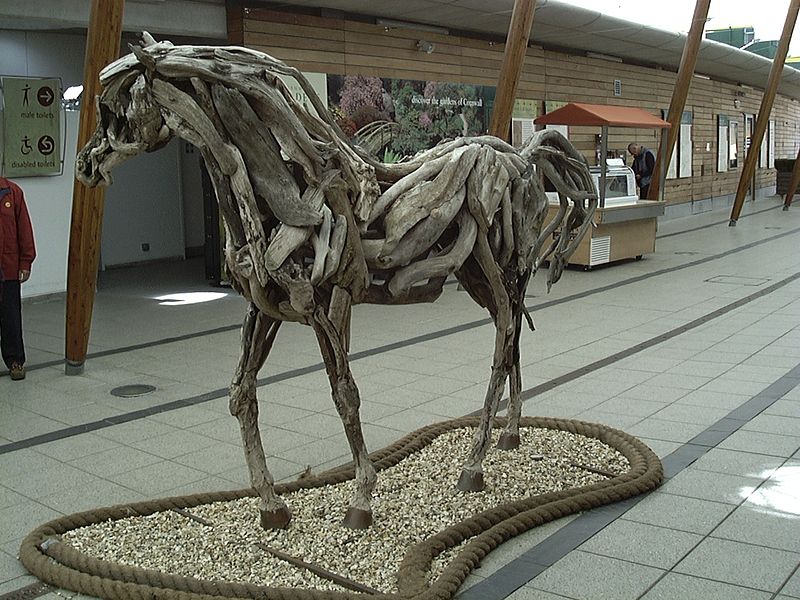
I think we call something art when we take the materials that we did not make, and put lots of effort and time into them. Simply taking driftwood and putting it in a museum isn't really art. People do, however, take driftwood, and they put time and effort into it, and at a point, it becomes art.
But, take for instance, gems. There are gems in museums that are large and uncut. They are simply taken from the earth, maybe cleaned up a bit, but that's it. People view them, and they might be considered art. I'm still not sure if they are art, but I'm sure some think they are so. Gems are very precious though. They're many factors in gems that people prize. Gems are almost universally attractive, too. In this case, I think we apply these non-artifacts as art, and subtract the need for it to be human-made.

Sunday, February 26, 2012
Week 5 Q&A 02
"2. How does Bell's definition of beauty contrast with Hume's “equality of taste?”
According to Hume, there is a natural equality of taste, but principles of taste are universal. While reading Clive Bell, I thought of Hume. Bell says that "all sensitive people agree that there is a peculiar emotion provoked by works of art." I thought what Hume said about principles of taste can be related to Bell. Also, Bell said "all systems of aesthetics must be based on personal experience" and that "we have no means of recognizing a work of art than our feeling for it." I think both philosophers would agree that people are not wrong by thinking something is attractive or beautiful, but some people are more right by their feelings for it.
According to Hume, there is a natural equality of taste, but principles of taste are universal. While reading Clive Bell, I thought of Hume. Bell says that "all sensitive people agree that there is a peculiar emotion provoked by works of art." I thought what Hume said about principles of taste can be related to Bell. Also, Bell said "all systems of aesthetics must be based on personal experience" and that "we have no means of recognizing a work of art than our feeling for it." I think both philosophers would agree that people are not wrong by thinking something is attractive or beautiful, but some people are more right by their feelings for it.
Week 5 Q&A 01
"1. Does aesthetic emotion have to have intent?"
The reason why I'm asking this is because of what Bell wrote on page 263: "I shall suggest...that some people may occasionally, see in nature what we see in art, and feel for her in aesthetic emotion..." I think I can agree with this. Strictly speaking, aesthetic emotion is based on the form, not the content of the art. The grass could have significant form, with the lines and colors and qualities to it. So, I don't think it has to have intent to create aesthetic emotion. However, if there is a sort of god that create the grass, then it could have intention, and thus still be sincere and create aesthetic emotion.
The reason why I'm asking this is because of what Bell wrote on page 263: "I shall suggest...that some people may occasionally, see in nature what we see in art, and feel for her in aesthetic emotion..." I think I can agree with this. Strictly speaking, aesthetic emotion is based on the form, not the content of the art. The grass could have significant form, with the lines and colors and qualities to it. So, I don't think it has to have intent to create aesthetic emotion. However, if there is a sort of god that create the grass, then it could have intention, and thus still be sincere and create aesthetic emotion.
Response to TA's question 05
"How does Clive Bell establish that the aesthetic world is a "world with emotions of its own" in which "the emotions of life find no place" (267)? Do you think he explains this fully? Can you think of reasons or examples as to why he is right/wrong?"
On page 266 in the second column, he says, "to appreciate a work of art we need to bring with us nothing from life, no knowledge of its ideas and affairs, no familiarity with its emotions. Art transports us from the world of man's activity to a world of aesthetic exaltation." He says a few pages before hand on 263, "all systems of aesthetics must be based on personal experience," and on 262, "we have no other means of recognizing a work of art than our feeling for it." The things he said on his earlier pages seem to contradict what he was saying. I'm not sure if these things actually go well with each other in Bell's view or not. Any insight is appreciated.
On page 266 in the second column, he says, "to appreciate a work of art we need to bring with us nothing from life, no knowledge of its ideas and affairs, no familiarity with its emotions. Art transports us from the world of man's activity to a world of aesthetic exaltation." He says a few pages before hand on 263, "all systems of aesthetics must be based on personal experience," and on 262, "we have no other means of recognizing a work of art than our feeling for it." The things he said on his earlier pages seem to contradict what he was saying. I'm not sure if these things actually go well with each other in Bell's view or not. Any insight is appreciated.
Sunday, February 19, 2012
'Art' by Yasmina Reza

"My friend Serge has bought a painting. It's a canvas about five foot by four: white. The background is white and if you screw up your eyes, you can make out some fine white diagonal lines."
I was not, and still not, sure of how to interpret this painting. I remember that most of the students in my class, if not all of them, did not understand what attracted Serge to this painting. The painting was an absurd amount of money (200k francs) for something that "simple." Everyone knows the stereotype beauty is in the eye of the beyholder. I just do not want to call it art. According to Tolstoy, art has to be infectious to be successful, and I think this piece would be unsuccessful due to its lack of infectiousness.
What do you think of the painting Serge bought? Would you consider it art?
Week 4 Q&A 02
2. If something does not lead to a “satisfactory culmination” to the artist, is it still art?
What made me think of this question is The Canterbury Tales. I am reading them for one of my classes, and it's well known that Chaucer did not complete them in his lifetime. There are other incomplete works that the artist did not finish (such as da Vinci's "The Last Supper") but are still appreciated to this day. So, my question is this: is the "satisfactory culmination" of a piece of art the same thing as the end? In my head, I think not.
However, I'm wondering if the "satisfactory culmination" is the same thing as the end for artists. In my writing, there is endless editing, and I think it's the same for countless other writers. Some authors get their works published, and when they go back, they are almost ashamed of the work many people love dearly. I am starting to think the "satisfactory culmination" is a subjective term. It can be complete to some, but not to others.
What made me think of this question is The Canterbury Tales. I am reading them for one of my classes, and it's well known that Chaucer did not complete them in his lifetime. There are other incomplete works that the artist did not finish (such as da Vinci's "The Last Supper") but are still appreciated to this day. So, my question is this: is the "satisfactory culmination" of a piece of art the same thing as the end? In my head, I think not.
However, I'm wondering if the "satisfactory culmination" is the same thing as the end for artists. In my writing, there is endless editing, and I think it's the same for countless other writers. Some authors get their works published, and when they go back, they are almost ashamed of the work many people love dearly. I am starting to think the "satisfactory culmination" is a subjective term. It can be complete to some, but not to others.
Week 4 Q&A 01
"1. If art is an experience, is someone reading a book and someone writing a book experiencing the same level of artistry?"
At first, I thought that they might be, according to Dewey's logic, but I thought on it. A person reading a book can experience many feelings, such as the ones the artist felt. And a person reading a book is having an experience, like Dewey said. A person writing a book is experiencing many feelings and they are also having an experience.
However, I think the difference between the two is the fact that the person reading a book is drawing from the author's experiences. Their experiences are most likely mingling with the authors, but the author has to draw completely from his own realm of experiences. I also think that a person reading a book adds an experience of reading a book to their general stream of experience, and for an author, it is much more significant. I do think they are both experiencing some level of artistry, but the author's is most certainly higher.
At first, I thought that they might be, according to Dewey's logic, but I thought on it. A person reading a book can experience many feelings, such as the ones the artist felt. And a person reading a book is having an experience, like Dewey said. A person writing a book is experiencing many feelings and they are also having an experience.
However, I think the difference between the two is the fact that the person reading a book is drawing from the author's experiences. Their experiences are most likely mingling with the authors, but the author has to draw completely from his own realm of experiences. I also think that a person reading a book adds an experience of reading a book to their general stream of experience, and for an author, it is much more significant. I do think they are both experiencing some level of artistry, but the author's is most certainly higher.
Response to TA's question 04
"Consider what Dewey has to say about the human experience, emotions, and the influence art has on these. Following Dewey's logic, what implications does capitalism then have not only on art, but on the human psyche and even humanity in general?
Do you think he has a point?
Give a possible solution to this dilemma."
In a capitalistic society, it is hard for everyone to get or own art, especially fine art or true art. Some people simply just have more money than others and possessing art is just out of the question.
I think this can make things harder for the people who cannot afford it. For example, there are many types of music, and some are better than others. But, in order for someone to understand the finest of music, that takes time and investments. For people on the lower end of a capitalistic society, they cannot meet the requisites. Popular music can be easily made without much skill, it's cheap, and does not take much to understand it. I think it affects the human psyche because people are thinking that "junk" art is art, and they aren't experiencing true art.
Do you think he has a point?
Give a possible solution to this dilemma."
In a capitalistic society, it is hard for everyone to get or own art, especially fine art or true art. Some people simply just have more money than others and possessing art is just out of the question.
I think this can make things harder for the people who cannot afford it. For example, there are many types of music, and some are better than others. But, in order for someone to understand the finest of music, that takes time and investments. For people on the lower end of a capitalistic society, they cannot meet the requisites. Popular music can be easily made without much skill, it's cheap, and does not take much to understand it. I think it affects the human psyche because people are thinking that "junk" art is art, and they aren't experiencing true art.
Sunday, February 12, 2012
Response to Chris Johnson
Link to original post.
I agree with Chris in many aspects. Sometimes, I get many different feelings from pieces of art and literature. It can be caused by different reasons: such as me not understanding the full history put in the work or because I did not understand the emotions. But, I, too, feel the same way. However, sometimes, I understand what the artist/author wants, and then I see my own meaning. In Tolstoy's opinion, I think the art or literature would be unsuccessful if it didn't communicate the same emotion or meaning the creator felt. But I'm not so sure. I think making anyone feel a certain way about something is an accomplishment. I can sometimes read something and feel nothing about it at all. I think the works that don't leave any impression are truly unsuccessful.
I agree with Chris in many aspects. Sometimes, I get many different feelings from pieces of art and literature. It can be caused by different reasons: such as me not understanding the full history put in the work or because I did not understand the emotions. But, I, too, feel the same way. However, sometimes, I understand what the artist/author wants, and then I see my own meaning. In Tolstoy's opinion, I think the art or literature would be unsuccessful if it didn't communicate the same emotion or meaning the creator felt. But I'm not so sure. I think making anyone feel a certain way about something is an accomplishment. I can sometimes read something and feel nothing about it at all. I think the works that don't leave any impression are truly unsuccessful.
Week 3 Q&A 02
"If true taste is based on reason, are instincts reason enough to find, for example, fire beautiful?"
To be honest, I'm not sure what I was originally thinking of when I asked this question. I do think instincts are a reason for us to act a certain way though.The instincts are not bad things either, so I think in a way, it can be reason enough. But, I don't think that Humes would think it's enough. It's not a logical enough reason. Instincts are very feeling based, so saying, "I think this because I feel that," then it's not logical. We must find reasons to back up our feelings about our true taste and how to defend them, but we do all have our natural preferences.
To be honest, I'm not sure what I was originally thinking of when I asked this question. I do think instincts are a reason for us to act a certain way though.The instincts are not bad things either, so I think in a way, it can be reason enough. But, I don't think that Humes would think it's enough. It's not a logical enough reason. Instincts are very feeling based, so saying, "I think this because I feel that," then it's not logical. We must find reasons to back up our feelings about our true taste and how to defend them, but we do all have our natural preferences.
Week 3 Q&A 01
"Are the most truly beautiful scenes/objects naturally occurring because they do not have cultural prerequisites to understand them?"
I think that the most universally beautiful things in nature do not have such requisites to understand them. After all, no one needs to understand culture or know different languages to find fire attractive. However, I think these beauties are simple, even instinctual. In my opinion, the most complex messages require basic knowledge, or even advanced knowledge. The more intellect poured into them, the heavier the message can be. It is entirely possible for the message to be too skewed for everyone but a few to understand it, too, so it can be both a good thing and a bad thing for it to be too complicated.
I think that the most universally beautiful things in nature do not have such requisites to understand them. After all, no one needs to understand culture or know different languages to find fire attractive. However, I think these beauties are simple, even instinctual. In my opinion, the most complex messages require basic knowledge, or even advanced knowledge. The more intellect poured into them, the heavier the message can be. It is entirely possible for the message to be too skewed for everyone but a few to understand it, too, so it can be both a good thing and a bad thing for it to be too complicated.
Response to TA's question 03
"My question is, what if Homer's Iliad and Odyssey had been written not thousands of years ago, but in this day and age? Disregarding that literature would be very different because of it, and assuming they were written as exactly the same pieces, how would we react? How would we react according to Hume's logic?"
I don't think they would be regarded in the same light as we view them today. I think the reason why they are so remarkable to us now was because literature was very young back then and while they are great, they were also the first to be great. If they were written today, I feel like they wouldn't get nearly as much attention as they do. After all, take a walk into any old bookstore. You can easily see a flood of literature on the market. Anything can be published. If it were written exactly the same, I do not think many people would give it the time of day. It would be too complicate for people to read compared to something else. I think the fact that because they stood the test of time and survived make them great, in that aspect.
I don't think they would be regarded in the same light as we view them today. I think the reason why they are so remarkable to us now was because literature was very young back then and while they are great, they were also the first to be great. If they were written today, I feel like they wouldn't get nearly as much attention as they do. After all, take a walk into any old bookstore. You can easily see a flood of literature on the market. Anything can be published. If it were written exactly the same, I do not think many people would give it the time of day. It would be too complicate for people to read compared to something else. I think the fact that because they stood the test of time and survived make them great, in that aspect.
Sunday, February 5, 2012
The Starry Night
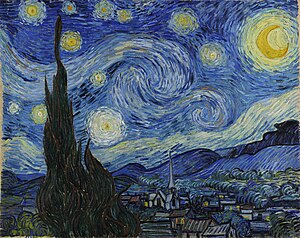
"The Starry Night" is easily Vincent van Gogh's most famous and well known painting. I recently found a website where you can zoom into the details of this particular painting. If you look closely at the painting on the link I provided, you can see many places of where the canvas is exposed. They are just small little places, but there's a lot of them, and because I've never seen this painting in real life, I never realized this about van Gogh's style.
His style is particularly unique with his wide brush strokes. I've always particularly liked how effortlessly it looked to create. What does it say about artists who can paint wonderful masterpieces, such as this, effortlessly? I've seen other paintings that were beautiful, but they took hours upon hours to complete. The precision is perfect in them is perfect. Does it have to be perfect? Are the artists who spend less time on their works better? I don't think so. I think the different styles that the artists of the world provide are all valuable. For some, art just comes to them more easily.
Week 2 Q&A 02
"Is insincere art that communicates an emotion strongly better than art that is very sincere but communicates an emotion poorly?"
This is a question I raised during class on Friday. Tolstoy states that the more infectious (or strongly) the art instills the desired emotion into the reader, the better it is. However, if the message the artist is trying to convey is sincere, then that is also good. However, in the case, which is better? Our TA brought up an example of someone who is mentally incapable of understanding emotions. Let's say they create a beautiful painting about sadness without feeling such sadness. The painting is so infectious that everyone who sees it feels the same sadness. What's wrong with this scenario is the fact that it's not a real communication. Communication seems to imply that everyone is on the same page. I do not think this is a true communication, and therefore, art.
However, art that is truly sincere communicates its emotion poorly, then I do not think it succeeded. It failed because it would not communicate its message efficiently.
In my opinion, if the second piece of art is able to communicate its emotion at all to any extent, then it's better than the first piece of art. Because in my mind, the first piece of art is not a true communication since the artist did not understand it. I think it would go by a case by case basis, because not all scenarios are this extreme. There can be different levels of sincerity in art.
This is a question I raised during class on Friday. Tolstoy states that the more infectious (or strongly) the art instills the desired emotion into the reader, the better it is. However, if the message the artist is trying to convey is sincere, then that is also good. However, in the case, which is better? Our TA brought up an example of someone who is mentally incapable of understanding emotions. Let's say they create a beautiful painting about sadness without feeling such sadness. The painting is so infectious that everyone who sees it feels the same sadness. What's wrong with this scenario is the fact that it's not a real communication. Communication seems to imply that everyone is on the same page. I do not think this is a true communication, and therefore, art.
However, art that is truly sincere communicates its emotion poorly, then I do not think it succeeded. It failed because it would not communicate its message efficiently.
In my opinion, if the second piece of art is able to communicate its emotion at all to any extent, then it's better than the first piece of art. Because in my mind, the first piece of art is not a true communication since the artist did not understand it. I think it would go by a case by case basis, because not all scenarios are this extreme. There can be different levels of sincerity in art.
Week 2 Q&A 01
1. If art is meant to communicate a specific emotion, then wouldn't propaganda be considered art? Propaganda may communicate thoughts, but it can scare people as well.
Based off of what I talked about in my Q&A and question last week, I started thinking of Tolstoy's possible opinion on propaganda as art. In his opinion, art is a communication of an emotion. In theory, art could be propaganda in possible circumstances. For example, if a piece of propaganda art succeeds in making people feel distrustful, or maybe fearful even, of a certain group of people, then I think that could be "art" in Leo Tolstoy's mind. Because if is a successful communication, doesn't that make it art? However, I'm not sure if propaganda successfully communicating thoughts or feelings telling people how to think can be considered art. Even if propaganda can be considered art, I don't think Tolstoy would agree. Art trying to convince people how think about others (and etc.) in my opinion, would disagree with Tolstoy's idea of universal brotherhood. Art should be bringing people together, not spreading hateful ideals. If someone is trying to use art to convince people to distrust others, then it is not real art.
Based off of what I talked about in my Q&A and question last week, I started thinking of Tolstoy's possible opinion on propaganda as art. In his opinion, art is a communication of an emotion. In theory, art could be propaganda in possible circumstances. For example, if a piece of propaganda art succeeds in making people feel distrustful, or maybe fearful even, of a certain group of people, then I think that could be "art" in Leo Tolstoy's mind. Because if is a successful communication, doesn't that make it art? However, I'm not sure if propaganda successfully communicating thoughts or feelings telling people how to think can be considered art. Even if propaganda can be considered art, I don't think Tolstoy would agree. Art trying to convince people how think about others (and etc.) in my opinion, would disagree with Tolstoy's idea of universal brotherhood. Art should be bringing people together, not spreading hateful ideals. If someone is trying to use art to convince people to distrust others, then it is not real art.
Response to TA's question 02
"How does artistic and creative quality figure in to Tolstoy's definition of art as a means to unite people and their emotions?"
I think this is a tough question, if I'm understanding it right. If art is a communication like Tolstoy says, then in order for it to be efficient, it needs to be clear. Creativity can be factored into art and help the communication, but if it's too "out there," then it might become unclear to the observers. Of course, I'm not saying it's a bad thing to incorporate creativity, but I think if it's vague or confusing, then the art is inefficient or a failure. If it cannot communicate correctly, then it does not support universal brotherhood.
I think this is a tough question, if I'm understanding it right. If art is a communication like Tolstoy says, then in order for it to be efficient, it needs to be clear. Creativity can be factored into art and help the communication, but if it's too "out there," then it might become unclear to the observers. Of course, I'm not saying it's a bad thing to incorporate creativity, but I think if it's vague or confusing, then the art is inefficient or a failure. If it cannot communicate correctly, then it does not support universal brotherhood.
Sunday, January 29, 2012
Art and Propaganda
During our class discussion, we talked about how there is a difference between propaganda and art. If I remember correctly, someone described propaganda to be something that influences how someone would normally feel. In that case, we could say that art that tries to make people feel a certain way (i.e. sad, mad, etc.) is also a type of propaganda. Dictionary.com defines propaganda as "information, ideas, or rumors deliberately spread widely to help or harm a person, group, movement, institution, nation, etc."
 During World War II, there was a lot of propaganda being spread around both sides. For example, this is propaganda poster for the Allies. It features a very stereotyped "German" with a long nose and fish lips. He looks coldly on the scene of an innocent person being hanged. Surely, one can not argue that this was definitely aimed at influencing how someone viewed Germans and the Axis Powers. However, the first time I ever came across this image was when it was being reprinted and sold as a poster. It was a part of a set of WWII propaganda posters with others such as "Loose Lips Sink Ships" and "Buy War Bonds." In other words, people buy these posters to hang in their homes. I'm sure people go as far as collecting the originals. So, does this mean that these posters cease being propaganda and become art? After all, I'm sure these people aren't buying them because they believe what they say to be true (at least in today's interest.)


So, with time, did these images cease being propaganda and become art? Are they history? I am not sure whether art has to be created with intention or not, but if it doesn't, then it very well could be art. However, can something be propaganda and art at the same time?
Saturday, January 28, 2012
Study Question 2
"What about things that cannot be created by craftsmen or by man, like, for example, a unicorn? What category does it fall into? Is art of a unicorn an imitation of an imitation or not?"
In my opinion, I think that the first person who conceived of a unicorn tapped into the world of forms. Then, it became depicted in stories and or art. Now, this is the part that I am slightly uncertain about; if people started putting unicorns on T-shirts and making them into stuffed animals, would the craftsmen who made them be making an imitation of an imitation? It's impossible to make a true unicorn, so would the craftsmen be aiming to create an ideal unicorn? In this case, I think that it could be argued that yes, the story of a unicorn might be less real and less useful than the stuffed animal unicorn, but wasn't it around first, and therefore, any "real" unicorns we see in our daily lives are imitations of an imitation.
Can we even apply what we know about the world of forms to things that do not exist, such as fictional characters? Does this fall into another category?
In my opinion, I think that the first person who conceived of a unicorn tapped into the world of forms. Then, it became depicted in stories and or art. Now, this is the part that I am slightly uncertain about; if people started putting unicorns on T-shirts and making them into stuffed animals, would the craftsmen who made them be making an imitation of an imitation? It's impossible to make a true unicorn, so would the craftsmen be aiming to create an ideal unicorn? In this case, I think that it could be argued that yes, the story of a unicorn might be less real and less useful than the stuffed animal unicorn, but wasn't it around first, and therefore, any "real" unicorns we see in our daily lives are imitations of an imitation.
Can we even apply what we know about the world of forms to things that do not exist, such as fictional characters? Does this fall into another category?
Study Question 1
"In the world of forms, the form of a couch is designated as “useful” and in our world, a couch we can use is “less useful.” Why is the idea of a couch useful rather than the actual object?"

On the board when we had the three forms of bed, the idea/form of the couch was designated as "useful," a physical couch we could use was designated as "less useful," and art of a couch was designated "less useful still." I do agree that the form of the couch is a good thing, because without the idea of it, we would have no couches, but aren't actual couches more useful? After all, a real couch, in my opinion, is infinitely more useful than the concept of one. You can't sit, sleep, relax, read, etc. on a concept. However, what I wonder is if couchmakers tap into the world of forms when they make a couch, or just copy the design of the couches we already have. If they are just copying a couch, doesn't the form of a couch lose its usefulness?

On the board when we had the three forms of bed, the idea/form of the couch was designated as "useful," a physical couch we could use was designated as "less useful," and art of a couch was designated "less useful still." I do agree that the form of the couch is a good thing, because without the idea of it, we would have no couches, but aren't actual couches more useful? After all, a real couch, in my opinion, is infinitely more useful than the concept of one. You can't sit, sleep, relax, read, etc. on a concept. However, what I wonder is if couchmakers tap into the world of forms when they make a couch, or just copy the design of the couches we already have. If they are just copying a couch, doesn't the form of a couch lose its usefulness?
Sunday, January 22, 2012
Philosophy Toolkit
This is not my first experience with the Philosophy Toolkit. What remains to be the most interesting part of the entire toolkit are the fallacies. It is amusing because many people use these informal fallacies and believe them to be truth. Ad populum is something I see so often. In the past, many people believed that slavery was alright because so many others thought it was okay, too.
Ad hominem is something we're seeing a lot these days because of the election that will occur later this year. Many people are disregarding the political opinions by of others by attacking them verbally. This also mixes in with ad populum, especially on certain cliquey websites. They will get in groups and attack and follow along with others, just because it seems like it's alright.
Ad hominem is something we're seeing a lot these days because of the election that will occur later this year. Many people are disregarding the political opinions by of others by attacking them verbally. This also mixes in with ad populum, especially on certain cliquey websites. They will get in groups and attack and follow along with others, just because it seems like it's alright.
Response to TA's question 01
"My question is, what about inventors? The person who came up with the couch, wheel, table, iPod? Does an "inventor" as such even exist?"
I don't think in Plato would think that the inventor of any such object was truly the "inventor." On page 25, Plato wrote, "here we have three sorts of couches, of which one exists in nature, and this we shall attribute...to the workmanship of god." He might argue that the concept of couch has always existed, regardless of whether the human mind thought of it or not. God, as many see it, is the creator of all and is all-knowing. So, the first person who invented a wheel might be the first human who made one, but God originally created the concept of the wheel - its true form - and any other wheel is an imitation of it. We can therefore argue that the idea of the iPod has always existed, along with the wheel, table, and every other object in existence. This also implies that there are a seemingly infinite amount of things that exist, but we do not know about them, at least yet.
I don't think in Plato would think that the inventor of any such object was truly the "inventor." On page 25, Plato wrote, "here we have three sorts of couches, of which one exists in nature, and this we shall attribute...to the workmanship of god." He might argue that the concept of couch has always existed, regardless of whether the human mind thought of it or not. God, as many see it, is the creator of all and is all-knowing. So, the first person who invented a wheel might be the first human who made one, but God originally created the concept of the wheel - its true form - and any other wheel is an imitation of it. We can therefore argue that the idea of the iPod has always existed, along with the wheel, table, and every other object in existence. This also implies that there are a seemingly infinite amount of things that exist, but we do not know about them, at least yet.
Wednesday, January 18, 2012
Introduction
My name is Catherine Obrzut, and I am a sophomore at MCLA. I am an English major with a concentration in literature, and after here, I plan to get my Master's in Library Science. I'm taking many classes this semester and I work part time in the Financial Aid office. I like to sew and do so whenever I have free time. I sew things for gifts and for my own personal use. I'm currently making a pair of pants. I enjoy sci-fi and fantasy, both in books and in media. I also am a huge fan of crime dramas and like to recite the intro the Law and Order: SVU.
I hope to get some insight about what makes art "art' this semester. I do not know much about the art world, so I hope this class will enlighten me and give me some new perspectives as well.
I hope to get some insight about what makes art "art' this semester. I do not know much about the art world, so I hope this class will enlighten me and give me some new perspectives as well.
Subscribe to:
Comments (Atom)