Link to original post.
It is very interesting to think of humans as artifacts. If humans are just artifacts of humans previous, then it's hard to say what isn't an artifact. Not considering how people raise children, just giving birth to a child could be considered creating an artifact. The majority of Mount Greylock can be an artifact because of the replanted trees. If we think like this, it's hard to think how many non-artifacts there are left in the world.
Thursday, March 29, 2012

Sunday, March 25, 2012
Response to TA's question 08
"Allen Carlson quotes Hepburn in saying that people who have the wrong sort of education or aren't in the right mindset to appreciate nature will either pay little heed to it or will look at it "the wrong way". Carlson seems to imply that for each setting there is a "right" mindset to have and way to view the landscape/ flower/ summer afternoon.
Is this true? Or is it possible that there are multiple "right" ways to view a natural environment? Or is there no "right" way and perhaps only shades of appreciation?"
I think there can be many ways to appreciate nature. For example, let's use the fibonacci spiral. In nature, the fibonacci spiral appears in plants and shells. A person who appreciates math may not know what type of flower it is or care what colors it has in it, but they can certainly appreciate the placement of the petals and how it spirals in such a way. A person who has no knowledge of math, but of flowers in general can appreciate the flower for much more beyond that. I think this can happen in shades too. Like, if you know of fibonacci numbers and that they appear in nature but not much more beyond the math concept, you may appreciate a few shades lighter of what the mathematician feels.
Is this true? Or is it possible that there are multiple "right" ways to view a natural environment? Or is there no "right" way and perhaps only shades of appreciation?"
I think there can be many ways to appreciate nature. For example, let's use the fibonacci spiral. In nature, the fibonacci spiral appears in plants and shells. A person who appreciates math may not know what type of flower it is or care what colors it has in it, but they can certainly appreciate the placement of the petals and how it spirals in such a way. A person who has no knowledge of math, but of flowers in general can appreciate the flower for much more beyond that. I think this can happen in shades too. Like, if you know of fibonacci numbers and that they appear in nature but not much more beyond the math concept, you may appreciate a few shades lighter of what the mathematician feels.
Sunday, March 18, 2012
Week 7 Q&A 02
"If Object A is perceptually indistinguishable from Object B and Object B is considered art, what is Object A?"
 If two things are perceptually indistinguishable from the other and one is art, it does not make the other thing art by proxy. Even if they are visually the same, the content and meaning behind the pieces can be completely different from each other. In the book, Danto used the Brillo Box example. The Brillo Boxes look no different from each other, but their content is completely different from each other. The Brillo Box in the museum is trying to make some statement about life or something. The Brillo boxes found in the store are just trying to hold the Brillo pads; that is it's only purpose. That's why the Andy Warhol pieces are in a museum, but all other Brillo Boxes are on Supermarket shelves.

Week 7 Q&A 01
"1. What about forgeries – can they be identified under “the is of artistic identification?"
I think when I asked myself this question I was really asking if forgeries could be considered art in Danto's point of view. Forgeries are simply copies. After a bit of thought, if forgeries are copies, then what about things that are reprinted? Poems and stories are printed countless times and they are simply copies of the original piece. Paintings are printed and they too are hung up and appreciated the same way. I think forgeries can be identified as art in some aspects, even without truly being art.
I think when I asked myself this question I was really asking if forgeries could be considered art in Danto's point of view. Forgeries are simply copies. After a bit of thought, if forgeries are copies, then what about things that are reprinted? Poems and stories are printed countless times and they are simply copies of the original piece. Paintings are printed and they too are hung up and appreciated the same way. I think forgeries can be identified as art in some aspects, even without truly being art.
Response to TA's question 07
"Danto says that the existing theories on art shape our view of art and enable us to see art at all.
Give an example from your own life in which you only fully understood and appreciated a work of art after it and the theory surrounding had been explained to you. Now think of a work of art you still dislike/don't understand and assess how an understanding of the theory behind it could change your mind."
Sometimes, I've read things, such as poetry, and I just didn't get it. Last year in one of my classes, I read a poem by an Irish author that dealt with a man who turned into a woman over night. I didn't understand what was going on in the poem at all, and I looked it up and found out that it was based on a very old folktale. After I got that, I appreciated it more in a way I didn't before.
Shakespeare is something I've never really understood. I read some things by him that I liked, but other stuff I didn't get into and just wrongly assumed it was overhyped. I definitely don't understand Shakespeare completely, but I've learned many things about it, and while reading his plays and prose, I have a great deal of respect for the man. For example, his use of language is something I didn't understand. I later found out he had a vocabulary of over 29000 words. From this, I've gotten a great appreciation of his use of language that I didn't have before.
Give an example from your own life in which you only fully understood and appreciated a work of art after it and the theory surrounding had been explained to you. Now think of a work of art you still dislike/don't understand and assess how an understanding of the theory behind it could change your mind."
Sometimes, I've read things, such as poetry, and I just didn't get it. Last year in one of my classes, I read a poem by an Irish author that dealt with a man who turned into a woman over night. I didn't understand what was going on in the poem at all, and I looked it up and found out that it was based on a very old folktale. After I got that, I appreciated it more in a way I didn't before.
Shakespeare is something I've never really understood. I read some things by him that I liked, but other stuff I didn't get into and just wrongly assumed it was overhyped. I definitely don't understand Shakespeare completely, but I've learned many things about it, and while reading his plays and prose, I have a great deal of respect for the man. For example, his use of language is something I didn't understand. I later found out he had a vocabulary of over 29000 words. From this, I've gotten a great appreciation of his use of language that I didn't have before.
Sunday, March 4, 2012
Week 6 Q&A 02
"2. Does Weitz's theory of art “cheapen” the value of great art?"
For closed definitions, like a square, no square is "better" than another. If it is, then the thing it's being compared to is probably not a square. All squares are squares, and that's simply that. But art has an open definition, and it's very subjective. People have preferences. If what a child draws with crayon is art, then it can be compared to the Mona Lisa. Modern art, which many do not appreciate, can then be compared to classic art. I think in this aspect, it can "cheapen" so called great art.
But, if crayon drawings and fine paintings fall under the same umbrella term, then what can you do to have certain types of art stand out in way that is different than others? We separate art into different categories. Music, for example, has many, many different categories. Let's make the assumption that all music is art; no one would dare put rap music in the same category as classical.
We have all these sub-definitions, so I don't think people should feel like it's being cheapened if they fall under the same umbrella terms. After all, the only real thing that art must have in common is that it's man-made. After that, wouldn't it be fair game?
For closed definitions, like a square, no square is "better" than another. If it is, then the thing it's being compared to is probably not a square. All squares are squares, and that's simply that. But art has an open definition, and it's very subjective. People have preferences. If what a child draws with crayon is art, then it can be compared to the Mona Lisa. Modern art, which many do not appreciate, can then be compared to classic art. I think in this aspect, it can "cheapen" so called great art.
But, if crayon drawings and fine paintings fall under the same umbrella term, then what can you do to have certain types of art stand out in way that is different than others? We separate art into different categories. Music, for example, has many, many different categories. Let's make the assumption that all music is art; no one would dare put rap music in the same category as classical.
We have all these sub-definitions, so I don't think people should feel like it's being cheapened if they fall under the same umbrella terms. After all, the only real thing that art must have in common is that it's man-made. After that, wouldn't it be fair game?
Week 6 Q&A 01
"How does Weitz's theory apply to non-artifacts?"
This is what I attempted to answer in the TA's question this week. I think for almost all cases of what we call art, it has to be human made. But, occasionally, non-artifacts can be called art. I think this is because we appreciate certain non-artifacts in ways that we don't appreciate others. Like I discussed in my TA response, gems are one of these things. Diamonds specifically have a very certain way of being evaluated. Diamonds are prized for their clarity, their cut, color, and karat. I find it interesting that diamonds can be grown in factories by the help of man. But often, natural diamonds are preferred over the man-made ones. I guess in a way, there can be artifact diamonds (man-made) and non-artifact diamonds (natural.) I think the way we hold diamonds can make them art themselves. The cut can make them more attractive pieces, too.
I do not think we can always suspend the idea that art must be man-made, but occasionally, or even just very rarely, we will be willing to set it aside.

This is what I attempted to answer in the TA's question this week. I think for almost all cases of what we call art, it has to be human made. But, occasionally, non-artifacts can be called art. I think this is because we appreciate certain non-artifacts in ways that we don't appreciate others. Like I discussed in my TA response, gems are one of these things. Diamonds specifically have a very certain way of being evaluated. Diamonds are prized for their clarity, their cut, color, and karat. I find it interesting that diamonds can be grown in factories by the help of man. But often, natural diamonds are preferred over the man-made ones. I guess in a way, there can be artifact diamonds (man-made) and non-artifact diamonds (natural.) I think the way we hold diamonds can make them art themselves. The cut can make them more attractive pieces, too.
I do not think we can always suspend the idea that art must be man-made, but occasionally, or even just very rarely, we will be willing to set it aside.

Response to TA's question 06
"Give reasons for and against the proposal that things, which are not human-made, could be called art. At which point do we call something human-made? (We make sculptures out of marble, but we don't make the marble, so could putting driftwood in a museum be sufficient to be called "human-made"?)"

I think we call something art when we take the materials that we did not make, and put lots of effort and time into them. Simply taking driftwood and putting it in a museum isn't really art. People do, however, take driftwood, and they put time and effort into it, and at a point, it becomes art.
But, take for instance, gems. There are gems in museums that are large and uncut. They are simply taken from the earth, maybe cleaned up a bit, but that's it. People view them, and they might be considered art. I'm still not sure if they are art, but I'm sure some think they are so. Gems are very precious though. They're many factors in gems that people prize. Gems are almost universally attractive, too. In this case, I think we apply these non-artifacts as art, and subtract the need for it to be human-made.

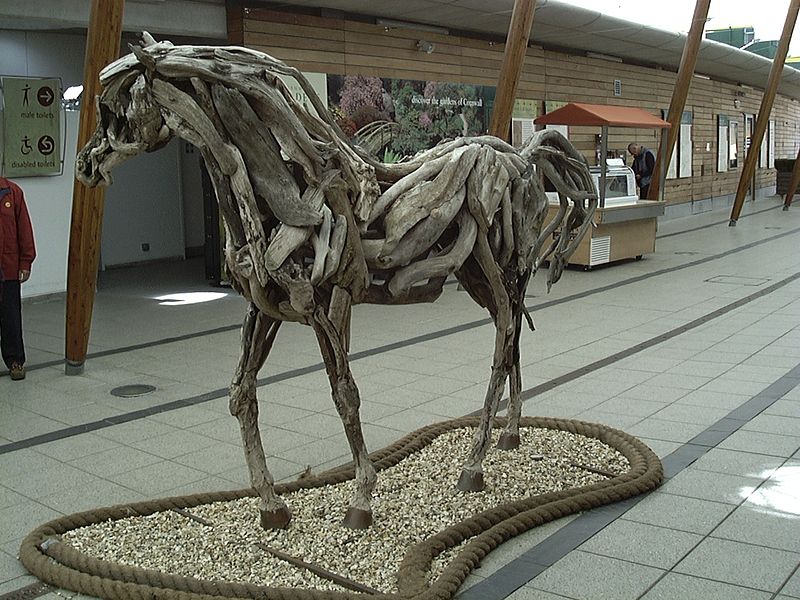
I think we call something art when we take the materials that we did not make, and put lots of effort and time into them. Simply taking driftwood and putting it in a museum isn't really art. People do, however, take driftwood, and they put time and effort into it, and at a point, it becomes art.
But, take for instance, gems. There are gems in museums that are large and uncut. They are simply taken from the earth, maybe cleaned up a bit, but that's it. People view them, and they might be considered art. I'm still not sure if they are art, but I'm sure some think they are so. Gems are very precious though. They're many factors in gems that people prize. Gems are almost universally attractive, too. In this case, I think we apply these non-artifacts as art, and subtract the need for it to be human-made.

Subscribe to:
Comments (Atom)