"2. How does Bell's definition of beauty contrast with Hume's “equality of taste?”
According to Hume, there is a natural equality of taste, but principles of taste are universal. While reading Clive Bell, I thought of Hume. Bell says that "all sensitive people agree that there is a peculiar emotion provoked by works of art." I thought what Hume said about principles of taste can be related to Bell. Also, Bell said "all systems of aesthetics must be based on personal experience" and that "we have no means of recognizing a work of art than our feeling for it." I think both philosophers would agree that people are not wrong by thinking something is attractive or beautiful, but some people are more right by their feelings for it.
Sunday, February 26, 2012

Week 5 Q&A 01
"1. Does aesthetic emotion have to have intent?"
The reason why I'm asking this is because of what Bell wrote on page 263: "I shall suggest...that some people may occasionally, see in nature what we see in art, and feel for her in aesthetic emotion..." I think I can agree with this. Strictly speaking, aesthetic emotion is based on the form, not the content of the art. The grass could have significant form, with the lines and colors and qualities to it. So, I don't think it has to have intent to create aesthetic emotion. However, if there is a sort of god that create the grass, then it could have intention, and thus still be sincere and create aesthetic emotion.
The reason why I'm asking this is because of what Bell wrote on page 263: "I shall suggest...that some people may occasionally, see in nature what we see in art, and feel for her in aesthetic emotion..." I think I can agree with this. Strictly speaking, aesthetic emotion is based on the form, not the content of the art. The grass could have significant form, with the lines and colors and qualities to it. So, I don't think it has to have intent to create aesthetic emotion. However, if there is a sort of god that create the grass, then it could have intention, and thus still be sincere and create aesthetic emotion.
Response to TA's question 05
"How does Clive Bell establish that the aesthetic world is a "world with emotions of its own" in which "the emotions of life find no place" (267)? Do you think he explains this fully? Can you think of reasons or examples as to why he is right/wrong?"
On page 266 in the second column, he says, "to appreciate a work of art we need to bring with us nothing from life, no knowledge of its ideas and affairs, no familiarity with its emotions. Art transports us from the world of man's activity to a world of aesthetic exaltation." He says a few pages before hand on 263, "all systems of aesthetics must be based on personal experience," and on 262, "we have no other means of recognizing a work of art than our feeling for it." The things he said on his earlier pages seem to contradict what he was saying. I'm not sure if these things actually go well with each other in Bell's view or not. Any insight is appreciated.
On page 266 in the second column, he says, "to appreciate a work of art we need to bring with us nothing from life, no knowledge of its ideas and affairs, no familiarity with its emotions. Art transports us from the world of man's activity to a world of aesthetic exaltation." He says a few pages before hand on 263, "all systems of aesthetics must be based on personal experience," and on 262, "we have no other means of recognizing a work of art than our feeling for it." The things he said on his earlier pages seem to contradict what he was saying. I'm not sure if these things actually go well with each other in Bell's view or not. Any insight is appreciated.
Sunday, February 19, 2012
'Art' by Yasmina Reza

"My friend Serge has bought a painting. It's a canvas about five foot by four: white. The background is white and if you screw up your eyes, you can make out some fine white diagonal lines."
I was not, and still not, sure of how to interpret this painting. I remember that most of the students in my class, if not all of them, did not understand what attracted Serge to this painting. The painting was an absurd amount of money (200k francs) for something that "simple." Everyone knows the stereotype beauty is in the eye of the beyholder. I just do not want to call it art. According to Tolstoy, art has to be infectious to be successful, and I think this piece would be unsuccessful due to its lack of infectiousness.
What do you think of the painting Serge bought? Would you consider it art?
Week 4 Q&A 02
2. If something does not lead to a “satisfactory culmination” to the artist, is it still art?
What made me think of this question is The Canterbury Tales. I am reading them for one of my classes, and it's well known that Chaucer did not complete them in his lifetime. There are other incomplete works that the artist did not finish (such as da Vinci's "The Last Supper") but are still appreciated to this day. So, my question is this: is the "satisfactory culmination" of a piece of art the same thing as the end? In my head, I think not.
However, I'm wondering if the "satisfactory culmination" is the same thing as the end for artists. In my writing, there is endless editing, and I think it's the same for countless other writers. Some authors get their works published, and when they go back, they are almost ashamed of the work many people love dearly. I am starting to think the "satisfactory culmination" is a subjective term. It can be complete to some, but not to others.
What made me think of this question is The Canterbury Tales. I am reading them for one of my classes, and it's well known that Chaucer did not complete them in his lifetime. There are other incomplete works that the artist did not finish (such as da Vinci's "The Last Supper") but are still appreciated to this day. So, my question is this: is the "satisfactory culmination" of a piece of art the same thing as the end? In my head, I think not.
However, I'm wondering if the "satisfactory culmination" is the same thing as the end for artists. In my writing, there is endless editing, and I think it's the same for countless other writers. Some authors get their works published, and when they go back, they are almost ashamed of the work many people love dearly. I am starting to think the "satisfactory culmination" is a subjective term. It can be complete to some, but not to others.
Week 4 Q&A 01
"1. If art is an experience, is someone reading a book and someone writing a book experiencing the same level of artistry?"
At first, I thought that they might be, according to Dewey's logic, but I thought on it. A person reading a book can experience many feelings, such as the ones the artist felt. And a person reading a book is having an experience, like Dewey said. A person writing a book is experiencing many feelings and they are also having an experience.
However, I think the difference between the two is the fact that the person reading a book is drawing from the author's experiences. Their experiences are most likely mingling with the authors, but the author has to draw completely from his own realm of experiences. I also think that a person reading a book adds an experience of reading a book to their general stream of experience, and for an author, it is much more significant. I do think they are both experiencing some level of artistry, but the author's is most certainly higher.
At first, I thought that they might be, according to Dewey's logic, but I thought on it. A person reading a book can experience many feelings, such as the ones the artist felt. And a person reading a book is having an experience, like Dewey said. A person writing a book is experiencing many feelings and they are also having an experience.
However, I think the difference between the two is the fact that the person reading a book is drawing from the author's experiences. Their experiences are most likely mingling with the authors, but the author has to draw completely from his own realm of experiences. I also think that a person reading a book adds an experience of reading a book to their general stream of experience, and for an author, it is much more significant. I do think they are both experiencing some level of artistry, but the author's is most certainly higher.
Response to TA's question 04
"Consider what Dewey has to say about the human experience, emotions, and the influence art has on these. Following Dewey's logic, what implications does capitalism then have not only on art, but on the human psyche and even humanity in general?
Do you think he has a point?
Give a possible solution to this dilemma."
In a capitalistic society, it is hard for everyone to get or own art, especially fine art or true art. Some people simply just have more money than others and possessing art is just out of the question.
I think this can make things harder for the people who cannot afford it. For example, there are many types of music, and some are better than others. But, in order for someone to understand the finest of music, that takes time and investments. For people on the lower end of a capitalistic society, they cannot meet the requisites. Popular music can be easily made without much skill, it's cheap, and does not take much to understand it. I think it affects the human psyche because people are thinking that "junk" art is art, and they aren't experiencing true art.
Do you think he has a point?
Give a possible solution to this dilemma."
In a capitalistic society, it is hard for everyone to get or own art, especially fine art or true art. Some people simply just have more money than others and possessing art is just out of the question.
I think this can make things harder for the people who cannot afford it. For example, there are many types of music, and some are better than others. But, in order for someone to understand the finest of music, that takes time and investments. For people on the lower end of a capitalistic society, they cannot meet the requisites. Popular music can be easily made without much skill, it's cheap, and does not take much to understand it. I think it affects the human psyche because people are thinking that "junk" art is art, and they aren't experiencing true art.
Sunday, February 12, 2012
Response to Chris Johnson
Link to original post.
I agree with Chris in many aspects. Sometimes, I get many different feelings from pieces of art and literature. It can be caused by different reasons: such as me not understanding the full history put in the work or because I did not understand the emotions. But, I, too, feel the same way. However, sometimes, I understand what the artist/author wants, and then I see my own meaning. In Tolstoy's opinion, I think the art or literature would be unsuccessful if it didn't communicate the same emotion or meaning the creator felt. But I'm not so sure. I think making anyone feel a certain way about something is an accomplishment. I can sometimes read something and feel nothing about it at all. I think the works that don't leave any impression are truly unsuccessful.
I agree with Chris in many aspects. Sometimes, I get many different feelings from pieces of art and literature. It can be caused by different reasons: such as me not understanding the full history put in the work or because I did not understand the emotions. But, I, too, feel the same way. However, sometimes, I understand what the artist/author wants, and then I see my own meaning. In Tolstoy's opinion, I think the art or literature would be unsuccessful if it didn't communicate the same emotion or meaning the creator felt. But I'm not so sure. I think making anyone feel a certain way about something is an accomplishment. I can sometimes read something and feel nothing about it at all. I think the works that don't leave any impression are truly unsuccessful.
Week 3 Q&A 02
"If true taste is based on reason, are instincts reason enough to find, for example, fire beautiful?"
To be honest, I'm not sure what I was originally thinking of when I asked this question. I do think instincts are a reason for us to act a certain way though.The instincts are not bad things either, so I think in a way, it can be reason enough. But, I don't think that Humes would think it's enough. It's not a logical enough reason. Instincts are very feeling based, so saying, "I think this because I feel that," then it's not logical. We must find reasons to back up our feelings about our true taste and how to defend them, but we do all have our natural preferences.
To be honest, I'm not sure what I was originally thinking of when I asked this question. I do think instincts are a reason for us to act a certain way though.The instincts are not bad things either, so I think in a way, it can be reason enough. But, I don't think that Humes would think it's enough. It's not a logical enough reason. Instincts are very feeling based, so saying, "I think this because I feel that," then it's not logical. We must find reasons to back up our feelings about our true taste and how to defend them, but we do all have our natural preferences.
Week 3 Q&A 01
"Are the most truly beautiful scenes/objects naturally occurring because they do not have cultural prerequisites to understand them?"
I think that the most universally beautiful things in nature do not have such requisites to understand them. After all, no one needs to understand culture or know different languages to find fire attractive. However, I think these beauties are simple, even instinctual. In my opinion, the most complex messages require basic knowledge, or even advanced knowledge. The more intellect poured into them, the heavier the message can be. It is entirely possible for the message to be too skewed for everyone but a few to understand it, too, so it can be both a good thing and a bad thing for it to be too complicated.
I think that the most universally beautiful things in nature do not have such requisites to understand them. After all, no one needs to understand culture or know different languages to find fire attractive. However, I think these beauties are simple, even instinctual. In my opinion, the most complex messages require basic knowledge, or even advanced knowledge. The more intellect poured into them, the heavier the message can be. It is entirely possible for the message to be too skewed for everyone but a few to understand it, too, so it can be both a good thing and a bad thing for it to be too complicated.
Response to TA's question 03
"My question is, what if Homer's Iliad and Odyssey had been written not thousands of years ago, but in this day and age? Disregarding that literature would be very different because of it, and assuming they were written as exactly the same pieces, how would we react? How would we react according to Hume's logic?"
I don't think they would be regarded in the same light as we view them today. I think the reason why they are so remarkable to us now was because literature was very young back then and while they are great, they were also the first to be great. If they were written today, I feel like they wouldn't get nearly as much attention as they do. After all, take a walk into any old bookstore. You can easily see a flood of literature on the market. Anything can be published. If it were written exactly the same, I do not think many people would give it the time of day. It would be too complicate for people to read compared to something else. I think the fact that because they stood the test of time and survived make them great, in that aspect.
I don't think they would be regarded in the same light as we view them today. I think the reason why they are so remarkable to us now was because literature was very young back then and while they are great, they were also the first to be great. If they were written today, I feel like they wouldn't get nearly as much attention as they do. After all, take a walk into any old bookstore. You can easily see a flood of literature on the market. Anything can be published. If it were written exactly the same, I do not think many people would give it the time of day. It would be too complicate for people to read compared to something else. I think the fact that because they stood the test of time and survived make them great, in that aspect.
Sunday, February 5, 2012
The Starry Night
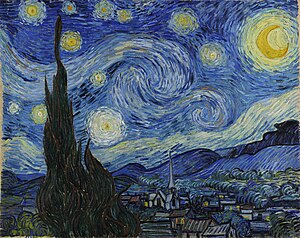
"The Starry Night" is easily Vincent van Gogh's most famous and well known painting. I recently found a website where you can zoom into the details of this particular painting. If you look closely at the painting on the link I provided, you can see many places of where the canvas is exposed. They are just small little places, but there's a lot of them, and because I've never seen this painting in real life, I never realized this about van Gogh's style.
His style is particularly unique with his wide brush strokes. I've always particularly liked how effortlessly it looked to create. What does it say about artists who can paint wonderful masterpieces, such as this, effortlessly? I've seen other paintings that were beautiful, but they took hours upon hours to complete. The precision is perfect in them is perfect. Does it have to be perfect? Are the artists who spend less time on their works better? I don't think so. I think the different styles that the artists of the world provide are all valuable. For some, art just comes to them more easily.
Week 2 Q&A 02
"Is insincere art that communicates an emotion strongly better than art that is very sincere but communicates an emotion poorly?"
This is a question I raised during class on Friday. Tolstoy states that the more infectious (or strongly) the art instills the desired emotion into the reader, the better it is. However, if the message the artist is trying to convey is sincere, then that is also good. However, in the case, which is better? Our TA brought up an example of someone who is mentally incapable of understanding emotions. Let's say they create a beautiful painting about sadness without feeling such sadness. The painting is so infectious that everyone who sees it feels the same sadness. What's wrong with this scenario is the fact that it's not a real communication. Communication seems to imply that everyone is on the same page. I do not think this is a true communication, and therefore, art.
However, art that is truly sincere communicates its emotion poorly, then I do not think it succeeded. It failed because it would not communicate its message efficiently.
In my opinion, if the second piece of art is able to communicate its emotion at all to any extent, then it's better than the first piece of art. Because in my mind, the first piece of art is not a true communication since the artist did not understand it. I think it would go by a case by case basis, because not all scenarios are this extreme. There can be different levels of sincerity in art.
This is a question I raised during class on Friday. Tolstoy states that the more infectious (or strongly) the art instills the desired emotion into the reader, the better it is. However, if the message the artist is trying to convey is sincere, then that is also good. However, in the case, which is better? Our TA brought up an example of someone who is mentally incapable of understanding emotions. Let's say they create a beautiful painting about sadness without feeling such sadness. The painting is so infectious that everyone who sees it feels the same sadness. What's wrong with this scenario is the fact that it's not a real communication. Communication seems to imply that everyone is on the same page. I do not think this is a true communication, and therefore, art.
However, art that is truly sincere communicates its emotion poorly, then I do not think it succeeded. It failed because it would not communicate its message efficiently.
In my opinion, if the second piece of art is able to communicate its emotion at all to any extent, then it's better than the first piece of art. Because in my mind, the first piece of art is not a true communication since the artist did not understand it. I think it would go by a case by case basis, because not all scenarios are this extreme. There can be different levels of sincerity in art.
Week 2 Q&A 01
1. If art is meant to communicate a specific emotion, then wouldn't propaganda be considered art? Propaganda may communicate thoughts, but it can scare people as well.
Based off of what I talked about in my Q&A and question last week, I started thinking of Tolstoy's possible opinion on propaganda as art. In his opinion, art is a communication of an emotion. In theory, art could be propaganda in possible circumstances. For example, if a piece of propaganda art succeeds in making people feel distrustful, or maybe fearful even, of a certain group of people, then I think that could be "art" in Leo Tolstoy's mind. Because if is a successful communication, doesn't that make it art? However, I'm not sure if propaganda successfully communicating thoughts or feelings telling people how to think can be considered art. Even if propaganda can be considered art, I don't think Tolstoy would agree. Art trying to convince people how think about others (and etc.) in my opinion, would disagree with Tolstoy's idea of universal brotherhood. Art should be bringing people together, not spreading hateful ideals. If someone is trying to use art to convince people to distrust others, then it is not real art.
Based off of what I talked about in my Q&A and question last week, I started thinking of Tolstoy's possible opinion on propaganda as art. In his opinion, art is a communication of an emotion. In theory, art could be propaganda in possible circumstances. For example, if a piece of propaganda art succeeds in making people feel distrustful, or maybe fearful even, of a certain group of people, then I think that could be "art" in Leo Tolstoy's mind. Because if is a successful communication, doesn't that make it art? However, I'm not sure if propaganda successfully communicating thoughts or feelings telling people how to think can be considered art. Even if propaganda can be considered art, I don't think Tolstoy would agree. Art trying to convince people how think about others (and etc.) in my opinion, would disagree with Tolstoy's idea of universal brotherhood. Art should be bringing people together, not spreading hateful ideals. If someone is trying to use art to convince people to distrust others, then it is not real art.
Response to TA's question 02
"How does artistic and creative quality figure in to Tolstoy's definition of art as a means to unite people and their emotions?"
I think this is a tough question, if I'm understanding it right. If art is a communication like Tolstoy says, then in order for it to be efficient, it needs to be clear. Creativity can be factored into art and help the communication, but if it's too "out there," then it might become unclear to the observers. Of course, I'm not saying it's a bad thing to incorporate creativity, but I think if it's vague or confusing, then the art is inefficient or a failure. If it cannot communicate correctly, then it does not support universal brotherhood.
I think this is a tough question, if I'm understanding it right. If art is a communication like Tolstoy says, then in order for it to be efficient, it needs to be clear. Creativity can be factored into art and help the communication, but if it's too "out there," then it might become unclear to the observers. Of course, I'm not saying it's a bad thing to incorporate creativity, but I think if it's vague or confusing, then the art is inefficient or a failure. If it cannot communicate correctly, then it does not support universal brotherhood.
Subscribe to:
Comments (Atom)